TL;DR
Tower climbers face a fatal injury rate of about 40 per 100,000 workers, more than 10 times the all industry average. Falls cause 73 percent of telecom fatalities and are largely preventable: Aura, the AI in ECSafety, detects missing PPE and flags fall protection noncompliance before crews ascend. Only 22 percent of EHS leaders currently have real time visibility into subcontractor PPE compliance.
Tower climbers face a fatal injury rate of 40 per 100,000 workers — more than 10× the all-industry average. Behind every statistic is a preventable failure in how the industry manages risk at height.
There is no other word for it: tower climbing is among the most dangerous occupations in North America. According to the Bureau of Labor Statistics Census of Fatal Occupational Injuries (BLS CFOI, 2024), telecommunications workers experience a fatality rate of approximately 40 per 100,000 full-time equivalent workers — compared to a 3.7 per 100,000 all-industry average and 9.6 per 100,000 in construction.
That is not a rounding error. It is a systemic failure — one that has persisted for decades and is now accelerating as the 5G buildout demands more tower modifications, more climbing crews, and more subcontractor coordination than the industry has ever seen before.
A Profession Built on Altitude and Exposure
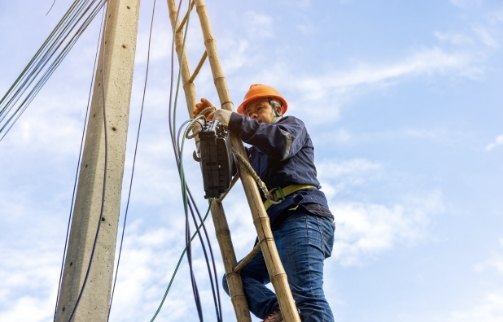
Tower climbing sits in a category of occupational risk that few industries match. Workers routinely operate at heights exceeding 500 feet, manage energized equipment in confined spaces, and perform critical structural work in weather conditions ranging from high winds to ice loading.
The combination of vertical exposure, multi-employer job sites, and compressed project timelines creates a compounding risk environment. Falls to a lower level account for 73% of fatalities in the telecom sector. Contact with objects and equipment (structural collapse, dropped tools, equipment failure) account for an additional 14%. These causes are well understood — and largely preventable.
"The telecom sector's fatality rate is not a new problem — it is a persistent one. The difference in 2026 is that the volume of work is accelerating faster than legacy safety programs can scale."
The 5G Expansion Effect
The 5G densification wave is not a future event — it is happening now, and it is putting unprecedented pressure on field safety programs. The CTIA estimates $40+ billion in annual U.S. wireless infrastructure investment through 2027, with the bulk of that spend concentrated on small cell deployments, macro tower modifications, and in-building distributed antenna systems (DAS).
- A single tower carrier swap or 5G antenna installation may require 6–12 separate subcontractor crews to complete (structural, electrical, climbing, testing, grounding, fiber)
- Each crew handoff is a compliance verification checkpoint — and in most organizations today, that verification still happens on paper or via email
- Crown Castle alone manages over 40,000 towers and 85,000+ small cells — manual compliance verification at this scale is operationally impossible without automation
⚠ The Structural Governance Problem
In telecom infrastructure, the tower owner sets the safety standard. The general contractor accepts responsibility for implementation. The subcontractor actually climbs the tower. Each layer of this supply chain introduces compliance risk — and most current systems cannot track that risk in real time. The National Association of Tower Erectors (NATE) estimates ~10,000 active tower climbing crews operating in the U.S. at any given time — the vast majority working for GCs and subs, not the tower owners.
What the Data Actually Tells Us
A 2025 National Safety Council survey of EHS leaders in infrastructure-intensive industries found the gap is stark:
| FINDING | PERCENTAGE |
|---|---|
| Said contractor safety compliance was their single greatest operational challenge | 68% |
| Had real-time visibility into subcontractor PPE compliance during active work | 22% |
| Experienced a preventable contractor-related safety incident in the past 12 months | 54% |
Only 22% of EHS leaders can see what their subcontractors are doing in the field — in real time. Yet 68% say it is their biggest challenge. That 46-point gap is the compliance blind spot that drives incidents.
The Regulatory and Financial Reality
Under OSHA's multi-employer worksite doctrine, a tower owner can be cited and penalized even when the injured worker is employed by a subcontractor — if the owner exercised control over the worksite or created the hazardous condition. OSHA's maximum penalty for a willful or repeat violation is $161,323 per citation (2025 adjusted rate).
On a 4-person climbing crew, one fall protection violation under OSHA's Instance-by-Instance (IBI) citation policy becomes four separate citations. A single serious incident at a multi-employer worksite can cascade into multiple citations across multiple entities, civil litigation, workers' compensation claims, project delays, and reputational damage.
💡 The Prevention Opportunity
Falls from height account for 73% of telecom tower fatalities — and they are largely preventable with real-time detection. AI-native platforms like ECSafety AI detect missing or improperly worn PPE, flag fall protection non-compliance before crew ascent, and monitor active work zones for evolving hazards without requiring dedicated safety personnel on-site. The technology exists. The question is whether organizations deploy it before the next preventable incident.
The Path Forward
The telecom infrastructure safety crisis is not a future risk — it is a present reality, accelerating with every new 5G tower modification and DAS deployment. AI-native safety platforms delivering real-time hazard detection, automated contractor compliance verification, and predictive risk intelligence reduce Year 1 incident rates by up to 40% — and yield demonstrable ROI within the first two quarters of deployment.
The question for every EHS Director reading this is not whether AI-native safety is the right direction. The question is how much the delay costs — in dollars, in risk, and in lives.
Go deeper
Download the full whitepaper
This article is drawn from The Invisible Risk Above the Skyline. The whitepaper has the complete data, the full ROI model, and the platform guide behind the numbers above.
Download the full whitepaper →