TL;DR
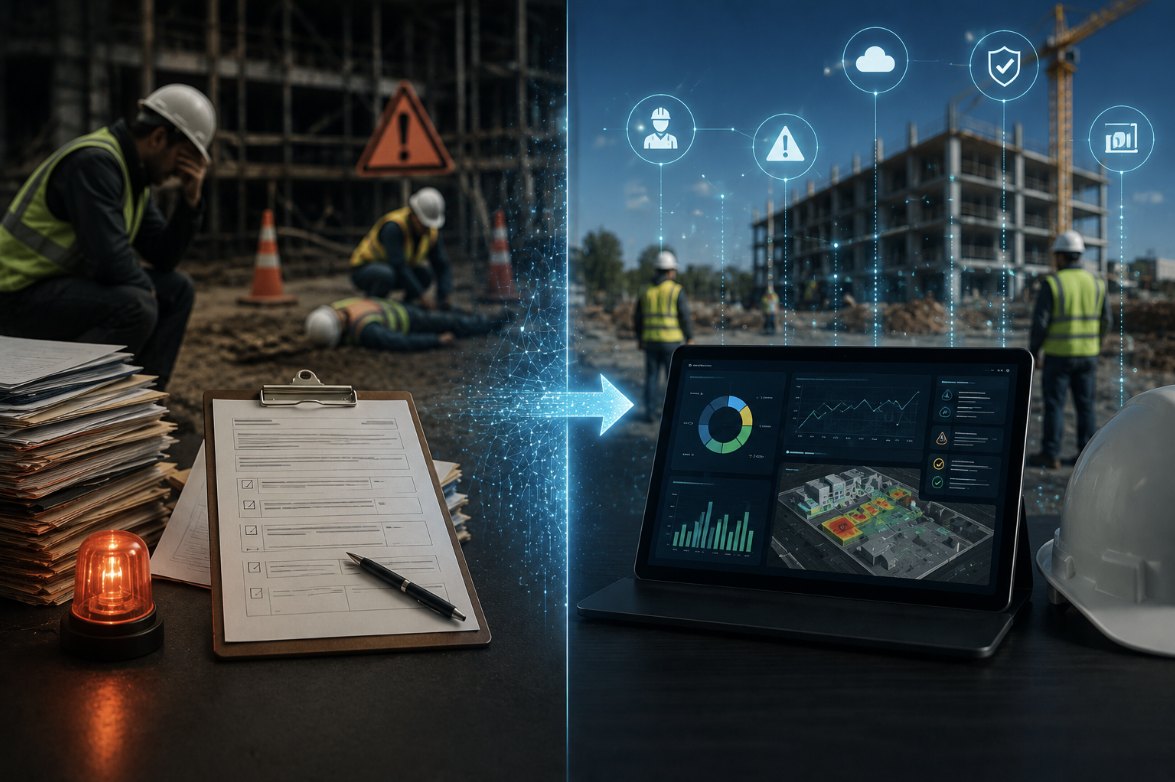
AI native safety platforms answer what is about to happen, not just what happened. Five traits separate them from rebranded automation: multimodal analysis, custom trained safety models, predictive risk detection, edge processing for privacy, and continuous learning. Early adopters report 15 to 42 percent reductions in recordable incidents, 12 to 28 percent EMR improvement, and 8 to 15 hours saved per safety manager each week.
Not all safety software that uses the word "AI" is AI-native. Many platforms apply basic automation or rule-based alerts to existing workflows and call it artificial intelligence. This distinction matters enormously — not just as a marketing claim, but as a practical predictor of whether a platform will actually reduce incidents or simply digitize the same reactive documentation process.
According to the Dodge Data & Analytics SmartMarket Report on Safety Management in Construction (2023), 67% of safety managers spend more than 10 hours per week on administrative tasks. Only 22% feel they have adequate time to conduct proactive site inspections. 54% cite lack of real-time field visibility as a top barrier to improving safety outcomes.
These statistics describe a structural problem: safety managers are spending only 7% of their working time on the activity most likely to prevent incidents. The rest is consumed by documentation of the past. Traditional EHS platforms — and most first-generation digital tools — are built to record and report what has already occurred. They are compliance artifacts, not prevention instruments.
The Technology Maturity Curve
EHS technology in construction sits on a five-level maturity curve. Most organizations are operating at Level 2. Level 4 — where AI-native prevention lives — is where measurable incident reduction becomes possible:
| LEVEL | NAME | CAPABILITY | OUTCOME |
|---|---|---|---|
| L1 | Reactive | Paper forms, manual logs | Document incidents |
| L2 | Digitized | Digital forms, basic software | Report faster |
| L3 | Integrated | Connected data, dashboards | See what happened |
| L4 ◄NOW► | Predictive | AI detection, real-time alerts | Prevent what's coming |
| L5 | Autonomous | Autonomous risk management | Self-healing safety [2028+] |
"By 2026, AI-augmented EHS systems will be a baseline expectation among enterprise buyers in high-risk industries. Organizations still operating at Level 2 or below will face measurable competitive and regulatory disadvantage."
What AI-Native Actually Means
Five characteristics separate genuine AI-native safety platforms from platforms that use the terminology without the underlying capability:
- Multimodal analysis: Processing images, video feeds, documents, and structured data simultaneously to identify risks no single data stream could reveal alone. A safety manager uploads a site photo; the AI identifies missing harnesses, an unsecured ladder, and a chemical label obstruction simultaneously.
- Custom-trained models: AI trained on safety-specific datasets — PPE identification, fall hazard geometry, near-miss pattern recognition — not general-purpose models adapted for safety. The difference is accuracy: general models confuse harness straps with tool belts. Specialized models don't.
- Predictive, not just descriptive: Identifying risk trends before incidents occur. If near-miss frequency at Site C is rising, an AI-native platform surfaces that pattern before it becomes a recordable incident.
- Edge processing for privacy: Analyzing camera feeds locally so no video data leaves the client's network. This addresses the #1 privacy concern in camera-based safety monitoring — a requirement for most enterprise procurement approvals.
- Continuous learning: Models that improve from each organization's specific environment and incident history. After 60–90 days, the AI understands your sites, your workflows, and your risk profile better than any manual inspection process can.
What Early Adopters Are Reporting
Organizations that have deployed AI-native safety platforms in construction and infrastructure settings are reporting outcomes that significantly outpace what legacy EHS tools achieve:
| OUTCOME METRIC | INDUSTRY RANGE | TOP QUARTILE |
|---|---|---|
| Reduction in recordable incidents | 15–42% | 42% |
| Improvement in EMR | 12–28% | 28% |
| Reduction in workers' comp costs | 18–35% | 35% |
| Time saved per safety manager/week | 8–15 hrs | 15 hrs |
| PPE compliance rate improvement | +20–45 pts | +45 pts |
| Audit cycle time reduction | 40–65% | 65% |
Source: NSC AI Safety Initiative Survey 2024; ECSafety AI customer data; CPWR Center for Construction Research and Training, 2024 Report
✓ The Shift in Plain Terms
Traditional safety tools answer the question: "What happened?" AI-native platforms answer the question: "What is about to happen, and how do we stop it?" That shift — from past-tense to present-tense — is what drives the 30–42% incident reduction that early adopters are reporting.
The Administration Problem, Solved
When AI pre-fills JSA forms based on work type, location, and historical risk patterns — reducing completion time by 60%+ — safety managers don't just save time. They redirect that time toward the proactive site inspection work that actually prevents incidents. The platform doesn't just automate compliance; it changes what people do with their recovered hours.
The organizations moving now are setting the EMR, insurance premium, and incident rate baselines that will define their competitive position for the next decade. The organizations waiting will inherit a widening gap.
Go deeper
Download the full whitepaper
This article is drawn from The True Cost of Reactive Safety in Construction. The whitepaper has the complete data, the full ROI model, and the platform guide behind the numbers above.
Download the full whitepaper →